What Should a Care Provider Do If CQC Hasn't Inspected Them for Years?

Key Takeaways
How common is it for a CQC rating to be years out of date?
Common enough to be the normal condition of the register rather than an exception. The Department of Health and Social Care's analysis for the Dash review, covering all sectors CQC regulates, found the average age of an overall rating had almost doubled in five years, from 2 years old in 2020 to approximately 3 years and 11 months old in 2024. The proportion of locations never rated under the previous inspection framework rose from 13% in 2019 to 19% in 2024.
The distribution inside that average is the part providers tend not to expect. As at 30 July 2024, Outstanding ratings were on average the oldest at 4 years and 11 months, while Inadequate ratings were the youngest at around a year old. Risk-based assessment pulls inspectors towards services where the data suggests a problem. The arithmetic consequence is that the better the last judgement, the longer the wait for the next one.
Two later figures show how far this has run in social care. CQC's State of Care 2024/25, published 24 October 2025, reported 3,062 adult social care ratings published under the single assessment framework, while 20,467 adult social care services still carry ratings from previous frameworks. CQC warns the two sets should not be combined or compared, since the newer framework rates individual services rather than locations. As a measure of how little of the rated estate has been revisited, the gap still lands.
In community social care the Homecare Association's June 2026 analysis of CQC's published directory found 83.5% of locations had no current rating: 36.9% never assessed, and 46.6% holding a rating four to ten years old. That cut-off is the Homecare Association's own definition, not CQC's, and the distinction matters, because CQC does not publish one.
Can a provider ask CQC to come and re-rate them?
No. There is no published mechanism for a provider to request an assessment or a re-rating. The two routes that do exist are both attached to an assessment CQC has already carried out, and neither can trigger fresh regulatory activity.
The factual accuracy check runs on the draft report. A provider has 10 working days from the date of the email to comment, and can correct typographical and numerical errors or challenge information it believes to be factually inaccurate with supporting evidence. CQC's guidance is explicit about the ceiling: where a provider supplies additional or omitted information, "unless there are exceptional circumstances, this new information will not form part of CQC's decision around final judgements or ratings (where appropriate)".
The rating process review runs after publication. CQC's current page, last updated 22 July 2026, states that "the only ground for requesting a rating process assurance review is that we have failed to follow our process for making rating decisions". It is not a further opportunity to reconsider the evidence or the judgements, unless CQC finds an error in its own quality control process.
The window for a rating process review is 15 working days from publication, one request only, 500 words, and the request must relate to the latest assessment that has awarded a rating. CQC warns that "all scores and ratings can go down as well as up as a result of a review", and describes it as the final CQC process for challenging a rating.
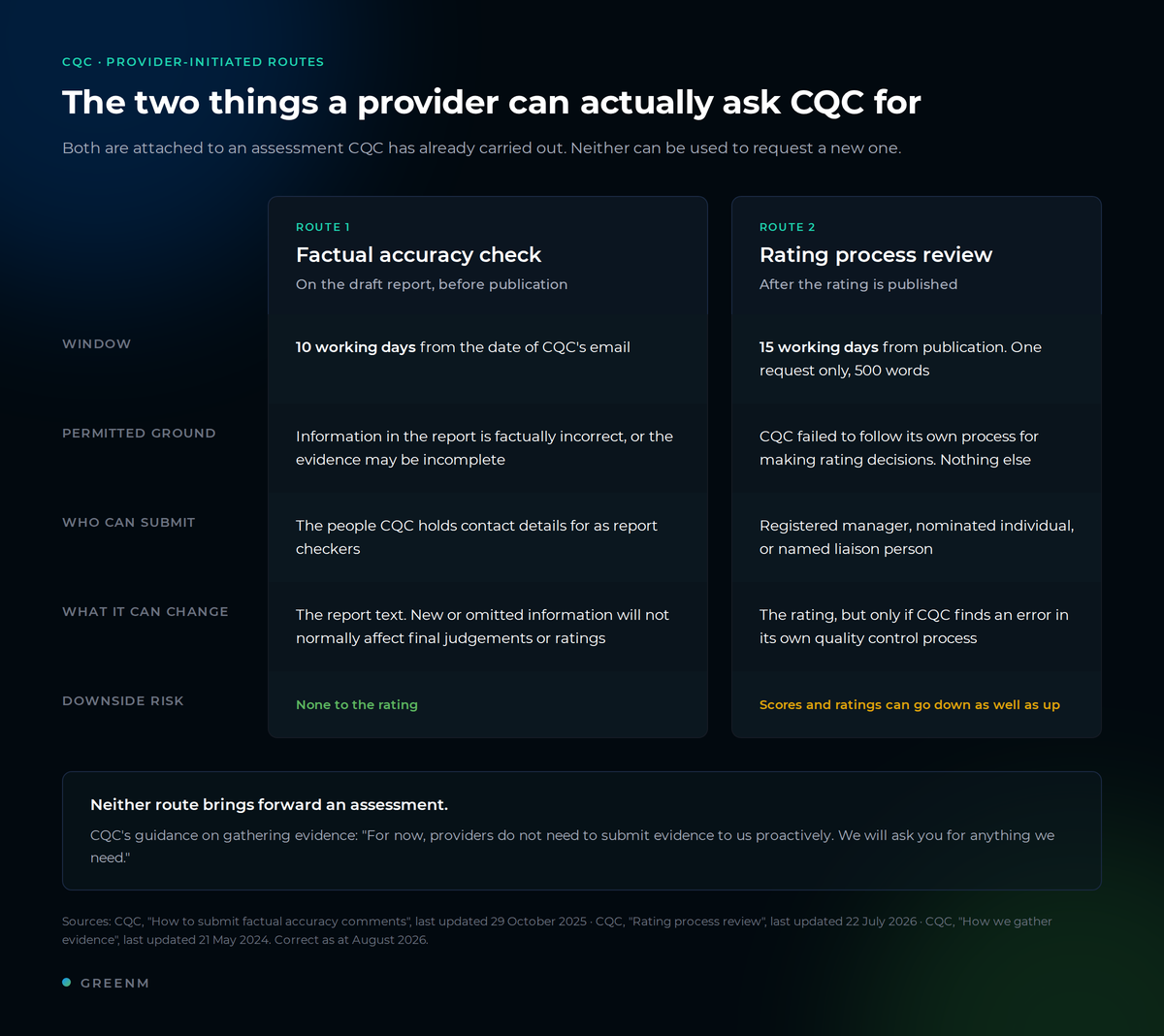
Outside those two windows, CQC's position on unsolicited evidence is direct. Its guidance on gathering evidence, last updated 21 May 2024, says: "For now, providers do not need to submit evidence to us proactively. We will ask you for anything we need."
What does influence the queue is CQC's published prioritisation. In "Priorities for delivering more assessments and tackling aged ratings", published 26 May 2026, CQC listed four adult social care priorities: services with urgent emerging risks, services never assessed since registration where the data indicates very high risk, services registered for over a year and not yet assessed, and services with a rating over six years old.
The same document describes a more proportionate route being rolled out for services that are rated Good in all five key questions, have a registered manager, have ratings over six years old, show no significant risk in the data CQC holds, and have no ongoing enforcement activity. CQC's caveat sits alongside it: "While we cannot specify when we will assess an individual service, the priorities outlined above for each sector give an indication of when we may assess."
Read as a lever rather than a timetable, that list says something usable. A registered manager in post, clean data, and no open enforcement are the conditions that move a service into the proportionate route. Three of the five are inside a provider's control.
Why does an old rating still carry legal and commercial weight?
Because the law gives it no expiry date, and requires the provider to publish it with a date attached.
Regulation 20A of the Health and Social Care Act 2008 (Regulated Activities) Regulations 2014, inserted on 1 April 2015, requires at least one sign at each premises showing the most recent rating for performance at those premises. On every website maintained by or on behalf of the provider it requires three things: CQC's website address, the place on CQC's website where the most recent assessment can be accessed, and the most recent rating itself. Regulation 20A(7)(c) requires each rating shown to carry "the date on which it was given by the Commission".
CQC's guidance on Regulation 20A, last updated 25 November 2025, confirms the duty applies to organisations rated before 1 April 2015, and that "in all instances, the most recent CQC rating is the one that should be displayed". Ratings must go up no later than 21 calendar days after CQC publishes them, and CQC can prosecute a breach without first serving a warning notice.
So the provider is legally required to publish its own staleness. A 2018 rating goes on the wall with 2018 next to it, and stays there until CQC returns.
That matters commercially because the rating is still the reference point other parties reach for. The Care and Support Statutory Guidance issued under the Care Act 2014, updated 22 July 2025, says at paragraph 4.106 that services delivered should have procedures in place to assure quality and value for money, "referencing the CQC standards for quality and CQC quality ratings".
NHS England's Provider Selection Regime statutory guidance names "all recent regulator inspection reports, including any issues related to quality they describe, overall quality ratings" among the evidence relevant to its quality and innovation criterion. That regime lists social care services as out of scope, so it bites on an adult social care provider only where it delivers NHS-commissioned healthcare.
For families the evidence base is thinner and older. The Competition and Markets Authority's care homes market study, published 30 November 2017, reported an Independent Age survey in which 29% of people with no prior experience of the sector would begin shortlisting through search engines, with 16% then looking at CQC ratings, and 22% saying they did not know where to look. The same study cited industry research suggesting 41% of UK care home residents self-fund.
Nine years on, no comparable Tier 1 research has replaced that survey. What has not changed is that the rating and its date are the only quality signal a family can find without asking the provider directly.
What should a provider publish alongside a stale rating?
Six things, in roughly this order.
1. Get the display itself right, including the date. A sign at each premises, and on every provider website the CQC address, the location of the assessment on CQC's site, and the rating, legible and conspicuous, with the date CQC gave it. Where a rating was inherited from a previous provider, CQC requires that this is made clear if the rating is displayed at all. An incomplete or inaccurate display is a separate breach from anything the rating itself says.
2. Publish a dated account of current quality next to it. CQC has not yet issued ratings posters for services assessed under the single assessment framework, and the templates it currently offers for those contain no space for provider context. On posters CQC generates from earlier ratings, the Requires improvement and Inadequate versions carry a box headed "Find out what we have changed since we received this rating from CQC", and CQC's guidance states that "all posters that CQC provide will include a space" for this. The constraint is tight: "You must only write within the box provided, but you can provide additional information next to the poster as long as it does not detract from it." The provider's own website is the larger space, and whatever goes there needs a date on it for the same reason the rating does.
3. Organise that account around the five key questions. Safe, effective, caring, responsive and well-led have survived every version of CQC's methodology since 2014, and CQC confirmed in March 2026 that they "remain fundamental to our assessments" under the new sector frameworks. Quality statements and percentage scoring do not survive. Evidence filed by key question keeps its value through the transition; evidence filed by quality statement or score does not.
4. Treat the Provider Information Return as the annual account it legally is. For adult social care the PIR is required under Regulation 17(3), arrives once per calendar year with a four-week deadline, and must be completed by the registered manager. CQC says it will primarily use the anniversary month of the location's first initial site visit, though it may send the invitation in a different month. It is the one channel that reaches CQC on a schedule regardless of whether an assessment is coming.
5. Give commissioners a standing quality pack rather than assembling one per tender. If paragraph 4.106 points a commissioner at a rating from 2019, the provider's alternative needs to exist before the question is asked, not during a procurement window.
6. Keep the data CQC already holds about the service accurate. Registered details, contact information, statement of purpose and statutory notifications all feed the picture CQC builds remotely. CQC ties contact details directly to the draft report check, on the same page that sets the 10 working day deadline: "It's important you make sure we have correct contact details for people who need to check the draft report when we carry out our assessment."
What evidence actually stands up when your rating doesn't?
The evidence Regulation 17 already requires, provided it is contemporaneous and dated.
Regulation 17(2) requires systems that assess, monitor and improve quality and safety, that assess and mitigate risk, that maintain "an accurate, complete and contemporaneous record" for each service user, and that "seek and act on feedback from relevant persons and other persons on the services provided".
CQC's guidance on Regulation 17, last updated 16 May 2025, says audits "should be baselined against Regulations 4 to 20A", and that providers "must be able to show how they have: analysed and responded to the information gathered, including taking action to address issues where they are raised, and used the information to make improvements and demonstrate that they have been made".
Regulation 20 adds a second dated trail. The duty of candour requires that notification of a notifiable safety incident is "recorded in a written record which is kept securely by the registered person", and that a copy of all correspondence sent under regulation 20(4) is kept. That record exists whether or not an inspector ever reads it.
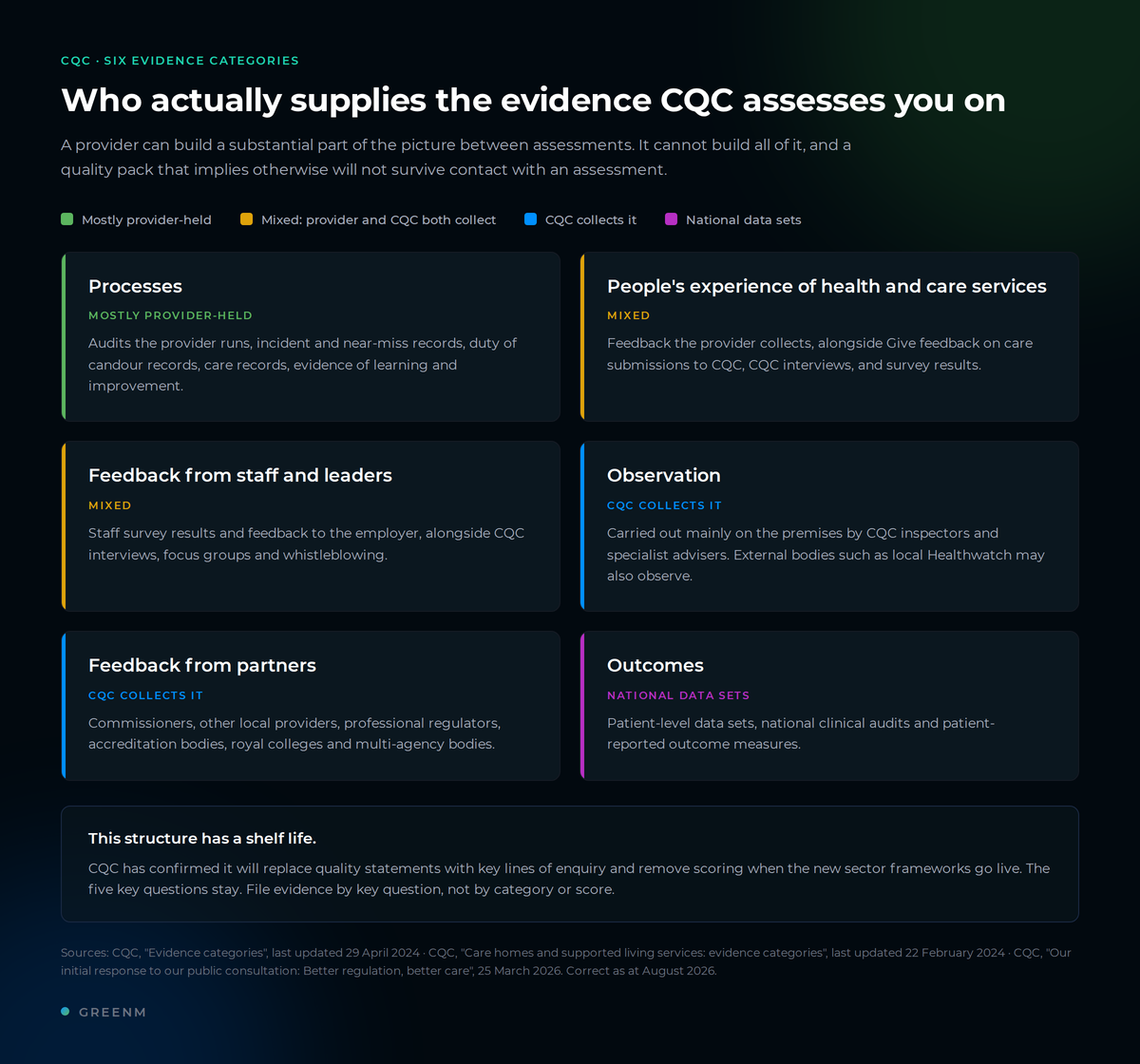
There is a ceiling worth naming. Under the framework in force at the time of writing, CQC groups evidence into six categories: people's experience of health and care services, feedback from staff and leaders, feedback from partners, observation, processes and outcomes.
A provider holds most of the processes evidence, and generates some of the people's experience and staff feedback evidence, though CQC collects both of those itself as well, through its Give feedback on care service, its own interviews and surveys, and whistleblowing. Observation is carried out mainly by CQC inspectors on site. Feedback from partners comes from commissioners, other local providers, professional regulators and royal colleges. Outcomes evidence is drawn largely from national data sets.
A provider can build a substantial part of that picture, and should. It cannot build all of it, and a quality pack that implies otherwise will not survive contact with an assessment.
How does the 2026 framework change affect a provider with an old rating?
It does not reset anything, and it makes the filing question urgent.
CQC's "Better regulation, better care" consultation closed on 11 December 2025 with 1,703 responses. In its initial response, published 25 March 2026, CQC confirmed that it will reintroduce sector-specific assessment frameworks and rating characteristics, replace quality statements with supporting key lines of enquiry, remove scoring from the assessment approach, and award ratings directly at key question level using structured professional judgement.
Four draft frameworks, including adult social care, were published alongside that response on 24 March 2026, and feedback closed on 12 June 2026. Pilots run from June to October 2026 with final evaluation in November 2026, and CQC has been explicit that pilot judgements "have no legal standing and will not affect regulatory status or rating". Its own formulation for the switch is that providers should keep using current guidance "until we implement the new regulatory approach later this year".
The consultation document also proposed that routine planned inspections "will generally take place on a 3 to 5-year cycle, depending on the type of service". That is a proposal, not a published schedule, and CQC's guidance still says frequencies remain to be decided.
For a provider carrying a 2018 rating, this means the rating was awarded under one framework, the framework that replaced it is being rewritten, and the rating stays on the wall throughout both transitions. The stable layer across all three versions is the five key questions. Our breakdown of the sector-specific frameworks goes through what changes for each of the four sectors.
How does GreenM approach evidence between inspections?
The evidence usually exists. It is rarely in one place, and almost never dated as a set.
Across the healthcare data work we have delivered, the pattern in adult social care is consistent: rostering sits in one system, incidents in another, care planning in a third, complaints in a shared inbox, training in a spreadsheet. Each system is adequate for the job it was bought for. What none of them produces is a single view, as at a given date, of open incidents by age, action completion, staffing adequacy and complaint resolution time. That view is what a quality pack needs, and building it is an integration problem before it is an analytics one.
GreenM builds that layer inside the organisation's own environment, which for providers handling care records is usually the only arrangement a data protection review will accept. The work is unglamorous: agreeing what each field means across systems, deciding what a closed action is, getting the dates to line up. Disconnected systems produce disconnected evidence, and the governance view leadership needs on one screen is the output providers reach for first. The shift towards continuous assessment is what makes the underlying unified data layer worth building rather than optional.
None of this makes CQC arrive sooner. It changes what a provider can evidence while waiting.
What are you currently able to show a commissioner about this quarter, without going into five systems to assemble it?
Frequently asked questions
Can I ask CQC to inspect my service?
No. CQC publishes no route for a provider to request an assessment or a re-rating. The two published provider-initiated processes are the factual accuracy check on a draft report and the rating process review after publication, and both relate to an assessment already carried out. The rating process review can only be requested on the ground that CQC failed to follow its own process for making rating decisions. CQC does carry out responsive assessments where it receives concerning information, so activity can be triggered, just not requested.
Do I have to display a CQC rating that is five years old?
Yes. Regulation 20A requires display of the most recent rating regardless of its age, and CQC's guidance confirms this includes ratings given before 1 April 2015. Regulation 20A(7)(c) also requires the date the rating was given to be shown. Ratings must be displayed within 21 calendar days of publication, and CQC can prosecute a breach without first serving a warning notice.
How long does a CQC rating last?
Indefinitely, until CQC publishes a new one. CQC does not publish a validity period for a rating, and as at August 2026 its guidance on assessment frequency still says new frequencies are to be decided and that it will publish "a date by when we will have updated all ratings for all providers". Where you see a three-year or four-year cut-off used to describe a rating as out of date, that is a third-party analytical convention rather than a CQC rule.
Will the 2026 framework change reset old ratings?
No. CQC's confirmed changes cover how future assessments are carried out and how ratings are awarded, including removing scoring and awarding ratings at key question level. Existing ratings remain published and remain subject to the Regulation 20A display duty. Pilot assessments running between June and October 2026 carry no legal standing and do not affect a service's rating.
Does an old rating affect local authority contracts?
It can. The Care and Support Statutory Guidance says services should have procedures in place to assure quality, referencing CQC quality ratings, and NHS England's Provider Selection Regime guidance names regulator inspection reports and overall quality ratings among the evidence relevant to quality, although social care services sit outside that regime's scope. Neither instrument sets a minimum rating nationally. Individual local authority frameworks may set their own thresholds, and those are local commissioning policy rather than national law.
Sources and further reading
- Department of Health and Social Care, Analysis of Care Quality Commission data on inspections, assessments and ratings, 2014 to 2024, annex to the Dash review full report, 15 October 2024.
- Dr Penny Dash, Review into the operational effectiveness of the Care Quality Commission: full report, Department of Health and Social Care, 15 October 2024.
- Care Quality Commission, State of Care 2024/25, Appendix: Ratings charts, 24 October 2025.
- Dr Jane Townson, Unseen and unrated: the widening CQC assurance gap in community social care, two years on, Homecare Association, 10 June 2026.
- Care Quality Commission, How often we assess, last updated 12 November 2025.
- Care Quality Commission, Priorities for delivering more assessments and tackling aged ratings, 26 May 2026.
- Care Quality Commission, Rating process review, last updated 22 July 2026.
- Care Quality Commission, How to submit factual accuracy comments, last updated 29 October 2025.
- Care Quality Commission, How we gather evidence, last updated 21 May 2024.
- The Health and Social Care Act 2008 (Regulated Activities) Regulations 2014, SI 2014/2936, regulation 20A.
- Care Quality Commission, Regulation 20A: Requirement as to display of performance assessments, last updated 25 November 2025.
- Care Quality Commission, How providers must display ratings, last updated 26 November 2025.
- Care Quality Commission, CQC widget and posters.
- The Health and Social Care Act 2008 (Regulated Activities) Regulations 2014, SI 2014/2936, regulation 17.
- Care Quality Commission, Regulation 17: Good governance, last updated 16 May 2025.
- The Health and Social Care Act 2008 (Regulated Activities) Regulations 2014, SI 2014/2936, regulation 20.
- Care Quality Commission, Provider information return (PIR): information for adult social care services, last updated 14 August 2024.
- Care Quality Commission, Evidence categories, last updated 29 April 2024.
- Care Quality Commission, Our initial response to our public consultation: Better regulation, better care, 25 March 2026.
- Care Quality Commission, Draft sector-specific assessment frameworks published for further feedback and views, 24 March 2026.
- Care Quality Commission, Piloting, testing and evaluation of new assessment method, 4 June 2026.
- Care Quality Commission, Better regulation, better care: consultation document, 14 October 2025.
- Department of Health and Social Care, Care and support statutory guidance, paragraph 4.106, updated 22 July 2025.
- NHS England, The Provider Selection Regime: statutory guidance, published 18 October 2023, last updated 7 November 2025.
- Competition and Markets Authority, Care homes market study: final report, paragraphs 2.25 and 9.14, 30 November 2017.