Private AI Infrastructurefor Healthcare Organizations
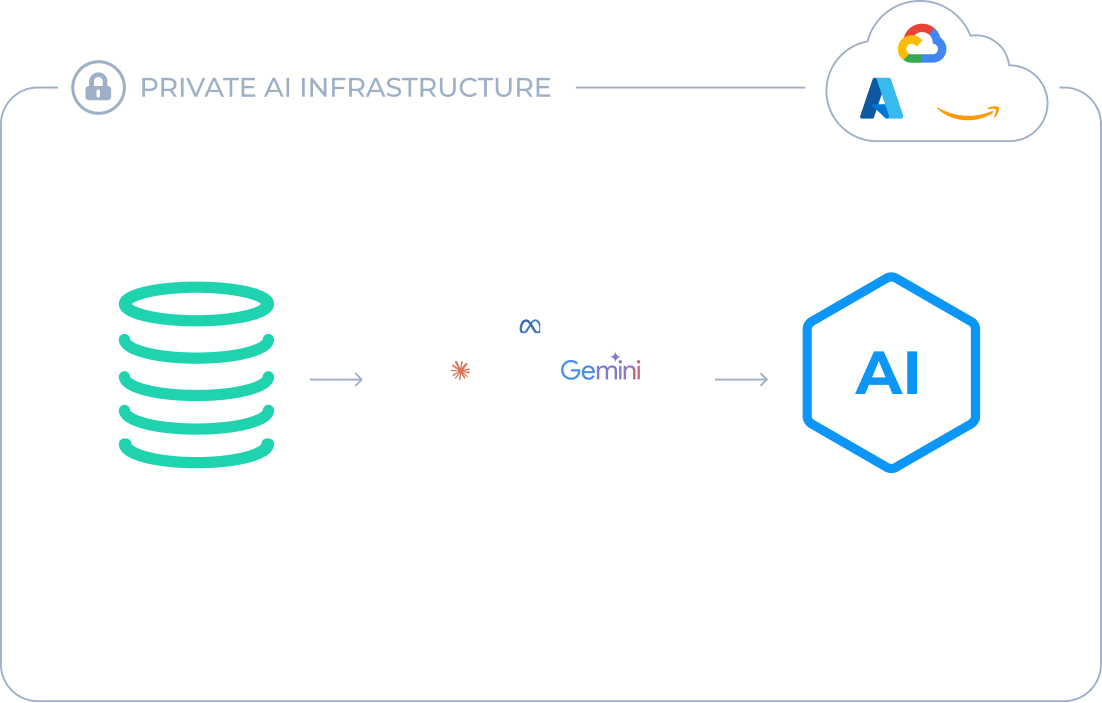
Self-hosted AI for healthcare. Deployed in your cloud or on-premises, so patient data never leaves your compliance boundary.
Not a SaaS tool on shared infrastructure. Your models, your governance, your audit logs, inside your environment.
Why Healthcare Needs a Private AI Foundation
Healthcare organizations need AI that works reliably in daily operations — because the barriers are structural: unclear ownership, no governance layer, and limited integration into clinical workflows
Pilot-to-Production Gaps
Production requires a stable deployment environment, defined ownership, and monitoring.
Governance and Safety Risks
AI without access controls, audit logging, and review processes creates compliance exposure.
Real-World Conditions Reliability
Clinical environments require a secure AI infrastructure built for operational use.
Cost and Usage Control
Without budget thresholds, AI costs grow undetected and shadow AI usage compounds the problem.
What Is a Private AI Foundation?
A private AI foundation is the operational layer that makes AI viable in a healthcare organization
It is the infrastructure, governance architecture, and integration patterns that allow your organization to run AI inside its own environment: private cloud or on-premises deployment, role-based access, audit logs, monitoring, and AI integrated into the systems your teams already use.
What Happens Without a Private AI Foundation?
Organizations that skip the foundational layer spend more time and budget later retrofitting governance, rebuilding integrations, and containing avoidable compliance exposure
Without Private AI Foundation
With Private AI Foundation
Governance
No ownership, no audit trail
Role-based access, full audit logging
Compliance
Shadow AI, documentation gaps
HIPAA, GDPR, NHS DSPT-aligned from day one
Model flexibility
Locked into one vendor
Model-agnostic — switch without rebuilding the stack
Structured deployment with reusable governance architecture
Private AI Foundation Capabilities
1
Controlled Deployment
Deploy inside your own infrastructure: Azure, AWS, GCP, or on-premises. GreenM builds it. Your team owns it.
2
Governance & Operations
Role-based access control, versioned templates, and full audit logging. Every automated action is traceable.
3
Model-Agnostic Architecture
Use commercial Large Language Models (LLMs) through private endpoints, or deploy a private LLM when requirements demand it. Switch without rebuilding the stack.
4
Monitoring and Cost Control
Usage dashboards, latency monitoring, budget thresholds, and anomaly alerts, so AI spend stays visible and controlled.
5
Clinical Workflow Patterns
Secure retrieval and controlled actions connect to your EHR, CRM, scheduling, and billing systems, so Protected Health Information (PHI) never leaves your environment.
The Impact of a Private AI Foundation
Up to 60% reduction in unmanaged AI usage
30–50% faster rollout of new AI initiatives
Predictable auditable outputs across all AI systems
Reusable governance and integration architecture
Structured transition from pilot to production
Key Use Cases Enabled
Clinical & Operational Copilots
Summaries, structured documentation, and workflow support — inside your environment, with every interaction logged.
Policy and Knowledge Assistants
Secure Q&A over internal policies and protocols. Retrieval grounded in approved sources, with role-based access and logging.
Controlled Agentic AI Workflows
Multi-step automation within approved limits — task routing with review controls, every automated action traceable.
Governance & Operations at Scale
As adoption expands, the foundation scales with it — same governance model and monitoring, no rebuilding required.
Success Stories
Real-world improvements in efficiency and care quality
“We went from discussing AI possibilities to having a working solution in under two months. The team understood healthcare — they didn't need us to explain HIPAA or clinical workflows.”
Clarify workflow ownership, governance requirements, and what success looks like three months after go-live.
2 Step
Deploy AI Inside Your Infrastructure
SSO and RBAC, encrypted storage, controlled model endpoints, network isolation — inside your cloud account or on-prem environment.
3 Step
Implement Guardrails and Safe Defaults
Scoped data access, versioned templates, human-in-the-loop checkpoints, and fallback logic — built into the architecture from day one.
4 Step
Make Reliability Visible (Monitoring + Cost Control)
Full observability: who used what, what it accessed, when, and what it cost.
5 Step
Enable Secure Workflow Integrations
A private AI foundation only delivers Clinical documentation, policy retrieval, and operational dashboards — connected through controlled, reviewable integration patterns.
Typical implementation: 4–8 weeks depending on governance scope and integrations.
Deployment in your private cloud account or on-prem environment.
No data egress: private models run isolated; commercial models via private endpoints under a Business Associate Agreement (BAA), zero retention.
HIPAA-aligned for US engagements; UK GDPR, Data Protection Act 2018, and NHS DSPT support for UK organizations. FHIR R4 for EHR integration.
Why Choose GreenM?
A Decade in healthcare
Exclusive focus on healthcare organizations, with proven experience across clinical workflows and complex operational environments.
Proven Methodology
A proven, low-risk approach that helps teams move from idea to production with clarity, speed, and measurable outcomes.
Deep System Integration
Native integration with EHR, CRM, and operational systems to enable automation across documentation, coordination, and communication.
Security & compliance
Built with HIPAA, NHS DSPT, GDPR, and FHIR principles to ensure security, compliance, and full organizational control.
Testimonials
I’ve leveraged technical help from GreenM on numerous consulting projects from basic AWS setup and administration to implementing complex design using serverless managed AWS services for rapid development of scalable solutions to clients. GreenM has always delivered on-time and is a great partner to collaborate with.
BJ Choi
SVP Engineering, Quantive Radianse
GreenM brings both deep expertise and a highly effective development team to every project they work on. In my time working with GreenM at NRCHealth, they not only delivered every project to spec and on time, but also elevated the level of our whole engineering department with their organizational and architectural best practices.
Alex Gallichotte
BI Department Lead, Fair
Great communication, fantastic partner, really smart about data and health data in particular. Senior Management are some of the best technical people I’ve ever worked with in more than 13 years. They consistently exceed expectations
Nathan Seaman
VP of Product, Human API
We have worked with Alexey and the team at GreenM on many projects and have consistently been impressed with the quality of their work. They hire very highly skilled individuals and strive to understand not just our immediate needs but the underlying issues and how we can improve the process.
GreenM team has a lot of experience with AWS. They have deployed several solutions. Their knowledge is up to date and I’d highly recommend them to anyone who needs to build BI/analytics leveraging AWS.
Leonid Nekhymchuk
Chief Technical Officer, VisiQuate Inc
GreenM is Starschema’s key partner from 2021. GreenM provided its services at a time when the market was looking for the most talented resources who are not only experienced but can also quickly manage the constantly changing technology world. GreenM quickly adapted to the Starschema working culture and high standards, and delivered technical professionals who could blend in easily. GreenM is a highly recommended partner for supporting the growth of any technical company with highly skilled and motivated professionals.
The governed operational layer that allows healthcare organizations to run AI inside their own environment — with access control, monitoring, and integration into existing workflows. It is the infrastructure and operating model that makes AI viable at production scale.
Do We Need to Run Our Own LLM?
Not necessarily. A model-agnostic architecture lets you use commercial models through private endpoints. A private LLM for healthcare can be deployed when regulatory requirements demand it. The architecture supports both paths without rebuilding the stack.
How Long Does It Take to Implement?
Typically 4–8 weeks depending on governance scope and integration complexity. The AI Launchpad delivers a working private AI deployment in 6 weeks.
Can This Run in Our Existing Cloud or On-Prem Infrastructure?
Yes. Deployment is inside your existing cloud account (Azure, AWS, or GCP) or on-premises — entirely within your infrastructure perimeter.
How Does the AI Integrate With Our Workflows (EHR, CRM, etc.)?
Secure retrieval and controlled actions connect to EHR, CRM, scheduling, and billing systems. We have experience with Epic, Cerner, Semble, Athenahealth, HubSpot, and Xero.
What's the Difference Between This and SaaS AI Tools?
SaaS AI tools run on shared infrastructure and send data to third-party models. This approach runs inside your environment — your infrastructure, your governance, your audit logs. For organizations with HIPAA, GDPR, or NHS DSPT obligations, this distinction is not optional.
Which vendors deliver end-to-end on-premise private AI for healthcare data privacy?
GreenM delivers the full stack inside your environment: infrastructure, model deployment, retrieval over your own records, governance, and audit logging. Nothing leaves your network.
Can you build a secure, on-premise LLM gateway for sensitive healthcare data?
Yes. GreenM builds private Large Language Model (LLM) gateways with role-based access, inline redaction of Protected Health Information, and an immutable audit trail, deployed in your data center or virtual private cloud.
How does private AI work under NHS DSPT and UK GDPR?
Deployment stays inside your UK-hosted environment. Data residency, NHS Data Security and Protection Toolkit (DSPT) alignment, and UK GDPR controls are enforced at the infrastructure layer. See our UK compliance overview.